About Imply Lumi
Imply Lumi helps you process and analyze observability and security data while drastically reducing event storage costs at scale.
Powered by the Imply storage and query engine, Lumi is a high-performance data warehouse for observability that efficiently stores and serves full-fidelity data. As a drop-in data layer, Lumi lets you:
- Retain and access more data: Keep data in your own Amazon S3 storage and search it in place, or send it to Lumi, at your desired fidelity for a fraction of your current costs.
- Accelerate your searches and queries: Run queries of any complexity or duration at the best price-performance.
- Operate as is: Continue using your existing observability tools and AI copilots.
- Decouple and expand possibilities: Decouple your data from a single vendor, avoid lock-in, and keep your data portable.
Unlike workarounds that require dropping data or switching tools to reduce the total cost of ownership, Lumi delivers lightning-fast search performance across your full dataset directly within an existing system like Splunk®.
You can try out this process end-to-end by following a series of tutorials using sample data or try it out with your own data:
- Tutorial data
- Your data
Not sure where to start? The quickstart introduces you to all the parts of Lumi using sample data.
Store and access your data
Lumi gives you two ways to make data searchable: connect Lumi to data that stays in your own Amazon S3 storage as external data, or send events to Lumi as managed data. We recommend external data for most use cases. You can use both in the same account.
The following diagram shows where each kind of data lives and how Lumi serves queries against it:
With external data, Lumi never ingests your data. Lumi accesses your source logs in-place from Amazon S3 and writes index files to an S3 location you choose.
With managed data, Lumi stores your events in two tiers:
- Hot tier: By default, Lumi copies all ingested data to the hot tier, which uses persistent storage and compute for the lowest latency and highest concurrency.
- Virtual tier: Tiering rules move data out of the hot tier after a retention period you set. Lumi loads that data on demand when a query needs it, at a lower cost than keeping it in the hot tier.
Queries against external data and the virtual tier run on virtual compute pools, which Lumi starts when a query needs them and stops after an idle time you configure. You need at least one virtual compute pool to use external data or the virtual tier.
You can search external data with the Lumi UI and Splunk federated search. You can search managed data with the Lumi UI, Splunk federated search, and other query integrations. For a side-by-side comparison, see External data overview.
Lumi architecture
The following diagram illustrates event data flowing into an existing observability system and into Lumi, either directly or through your Amazon S3 storage.
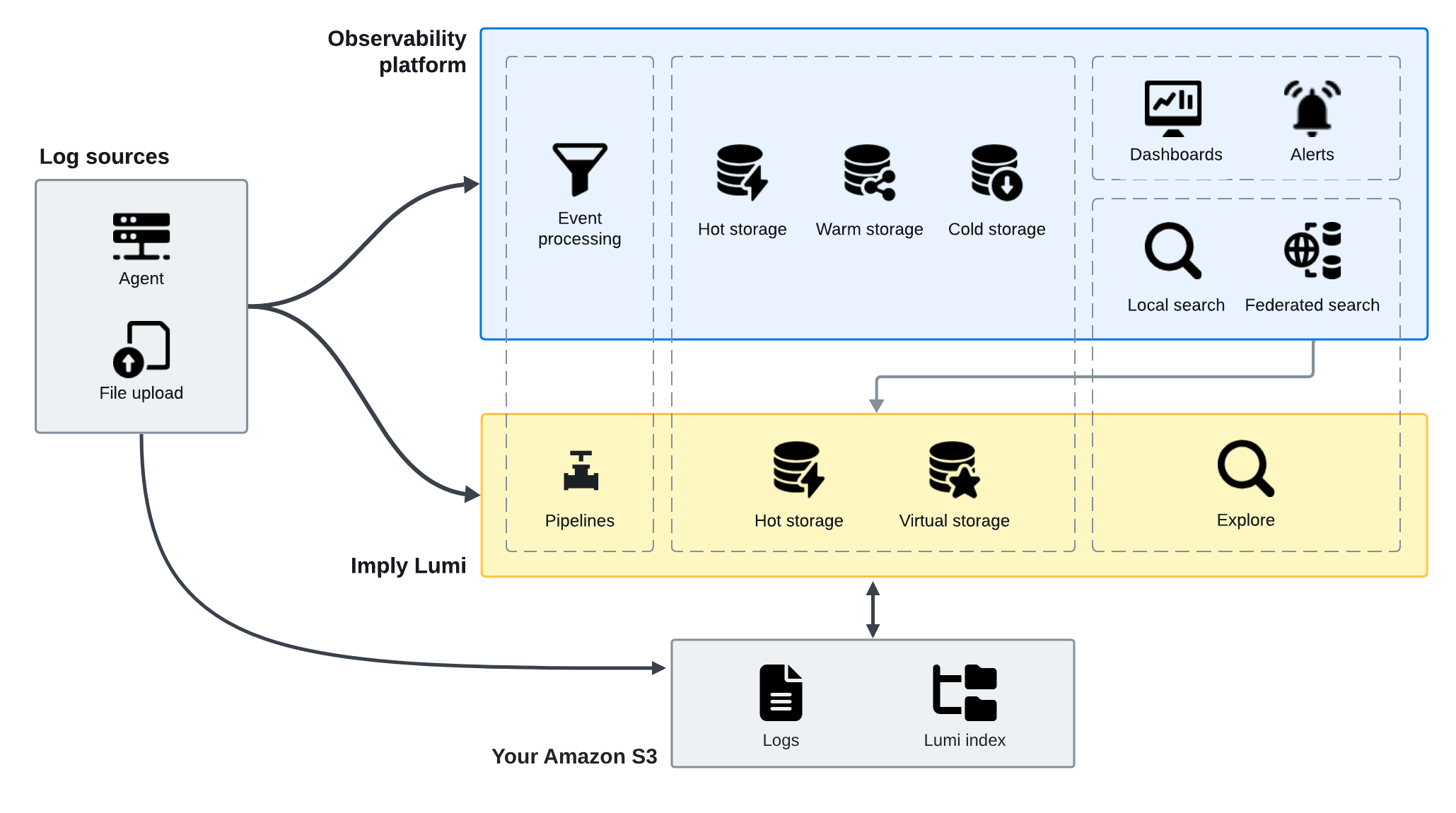
Imply Lumi is available in multiple Amazon Web Services (AWS) regions. For details, see Cloud regions.
You can search external data and managed data through the Lumi UI and from federated search in an existing system like Splunk.
Imply offers the following deployment models of Lumi:
- Lumi Cloud
- Lumi Cloud is a highly available, fully managed SaaS offering hosted by Imply. External data stays in your Amazon S3 storage. Lumi stores managed data in the Imply AWS account. Imply operates the infrastructure, handles updates, scaling, security, and compliance. This offering is suitable for organizations that want rapid deployment, minimal maintenance, and managed scalability.
- Lumi Enterprise
- Lumi Enterprise is a self-managed version of Lumi. You install and run Lumi Enterprise in your own cloud environment. You manage the infrastructure, scaling, security, and compliance. You apply upgrades as they are released, according to a schedule you determine. This offering is suitable for organizations that require full control and have strict data sovereignty, security, and compliance requirements.
Quickstart
Learn how to upload web logs to Imply Lumi, explore sample data from a fictional online store, and query events using simple search syntax.
External data overview
Learn how Imply Lumi queries data in your own Amazon S3 storage without ingesting it, and how it compares to managed data.
Federated search reference
Learn which SPL commands, syntax, and functions Imply Lumi supports for federated search. Query event data using Splunk® Search Processing Language.
Event model
Learn how Lumi processes and stores event data with timestamps, messages, and searchable attributes to power observability and monitoring workflows.
Event lifecycle
Learn how Lumi collects, processes, and stores events through integrations, pipelines, and receivers. Discover the complete event lifecycle.