Lumi Cloud storage metrics
AI summary
About AI summaries.
This is an early access feature. Recommendations in this topic are subject to change.
Imply Lumi Cloud provides storage metrics to help you understand how your data is distributed across tiers. Monitoring storage metrics is especially useful for managing costs, planning capacity, and verifying that your tiering rules work as expected. For help adjusting your Lumi configuration in response to these metrics, contact your Imply support representative.
This topic describes storage metrics for Lumi Cloud.
Prerequisites
To view storage metrics, you need the Admin role. For information on roles and permissions, see Manage roles.
View storage metrics
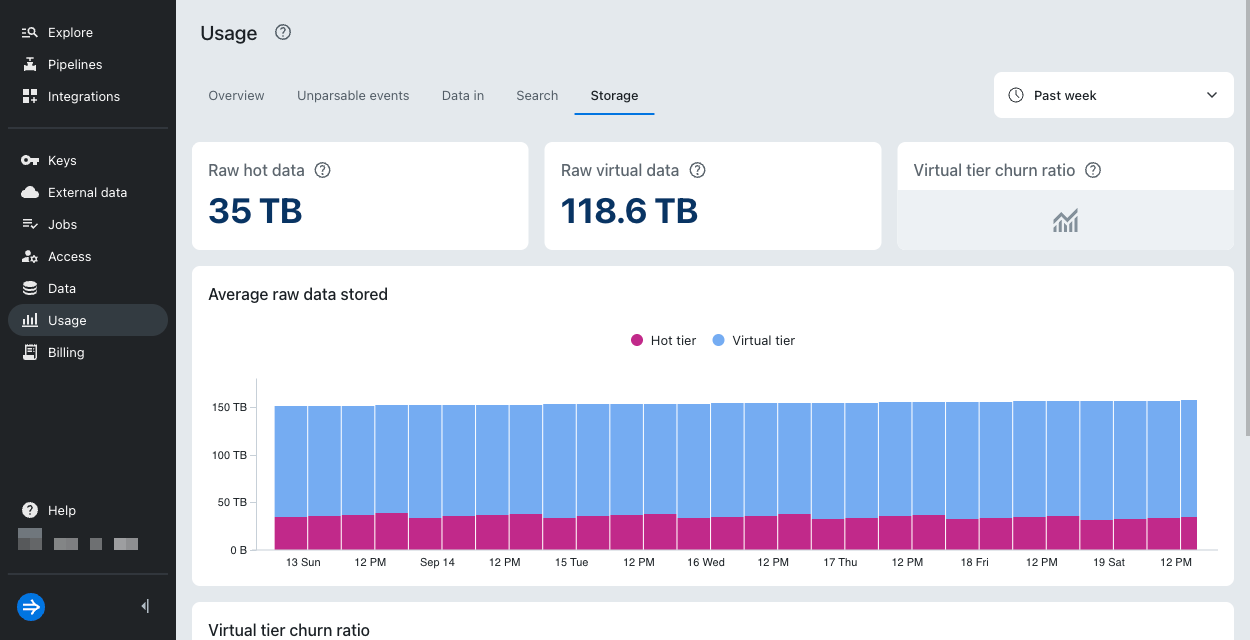
To view storage metrics, click Usage in the navigation menu, then click the Storage tab.
Raw data
The raw data metrics show the average size of raw data distributed across the hot and virtual tiers over the selected time period. Use these metrics to determine whether your current tier capacity is appropriate for your workload. For example, if you have a large amount of data in hot storage and your churn ratio is low, consider adding:
- A tiering rule to evict data from hot storage
- A deletion rule to remove unnecessary data
Average raw data stored
Shows the average amount of raw data stored per tier over the selected time period. Use this metric to track your typical storage footprint and compare how much data is stored in each tier over time.
Virtual tier churn ratio
Shows the percentage of data evicted from virtual storage relative to the data scanned by queries. The evicted data gets reloaded into virtual storage as needed.
- Below 50%: Your virtual tier is properly sized. Consider gradually reducing your virtual tier infrastructure to find the right balance between cost and performance. Note that 0% churn doesn't signify that there is an issue. It could mean that virtual storage already contains the data that satisfies the queries.
- Above 50%: Your virtual tier may be undersized. Consider increasing virtual tier infrastructure or expanding the hot data retention period.
Learn more
For more information, see the following topics:
- Configure tiering rules to use a virtual tier.
- Configure deletion rules to set up automatic data deletion.
- Send events to Lumi for different ways you can send events to Lumi.